
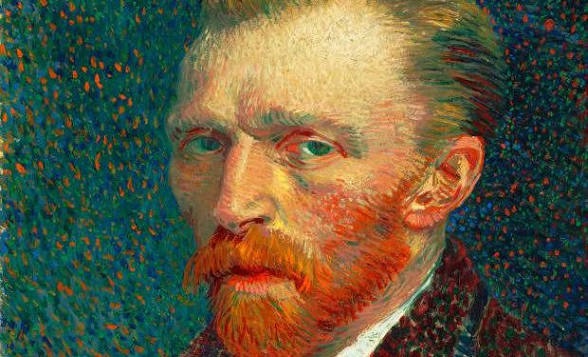
Vincent van Gogh is perhaps the most iconic figure in art history. Known for his swirling brushstrokes, vibrant palettes, and a life defined by both immense creativity and profound suffering, his legacy transcends the canvas. To understand his art, one must delve into the turbulent biography that fueled his masterpieces.
Early Struggles and the Search for Purpose
Before becoming the painter we know today, Van Gogh explored various paths, including being an art dealer and a lay preacher in a Belgian mining district. These early experiences deeply influenced his empathy for the working class, a theme evident in his somber, early masterpiece:
The Potato Eaters (1885): This work showcased his ability to capture the raw, gritty reality of peasant life. Unlike the bright colors of his later years, this period was dominated by “earthy” tones—browns and dark greens.
The Move to Paris and the Impressionist Influence
In 1886, Vincent moved to Paris, a turning point that revolutionized his style. Encountering the works of Claude Monetand Georges Seurat, he began to experiment with:
Short, broken brushstrokes.
Vibrant, contrasting colors.
Japanese Ukiyo-e prints, which taught him about bold outlines and unconventional perspectives.
The Arles Period and Mental Decline
Seeking “the light of the South,” Van Gogh moved to Arles in 1888. This was his most prolific period but also the beginning of his most severe mental health crises. It was here that he famously cut off part of his left ear following a confrontation with fellow artist Paul Gauguin.
During this time, he produced legendary works such as:
Sunflowers: Symbolizing gratitude and the warmth of the sun.
The Yellow House: A symbol of his dream of an artist’s colony.
Asylum and “The Starry Night”
While voluntarily staying at the Saint-Paul-de-Mausole asylum in Saint-Rémy-de-Provence, Van Gogh reached the pinnacle of his Post-Impressionist style. Despite his confinement, he looked out of his window and saw the cosmos.
“I often think that the night is more alive and more richly colored than the day.”
The Starry Night (1889) is more than just a landscape; it is a visual representation of his internal turbulence, using expressive swirls to convey a sense of movement and spiritual energy.
Death and Lasting Impact
Vincent van Gogh passed away in July 1890 at the age of 37, following a self-inflicted gunshot wound. Tragically, he only sold one painting during his lifetime (The Red Vineyard).
How he changed art forever:
Expressionism: He proved that art should express the artist’s feelings rather than just a realistic depiction of the world.
Color Theory: His bold use of complementary colors (yellow vs. purple, blue vs. orange) changed how future generations approached the canvas.
Fauvism & Modernism: Artists like Henri Matisse and Francis Bacon cited Van Gogh as a primary influence.
